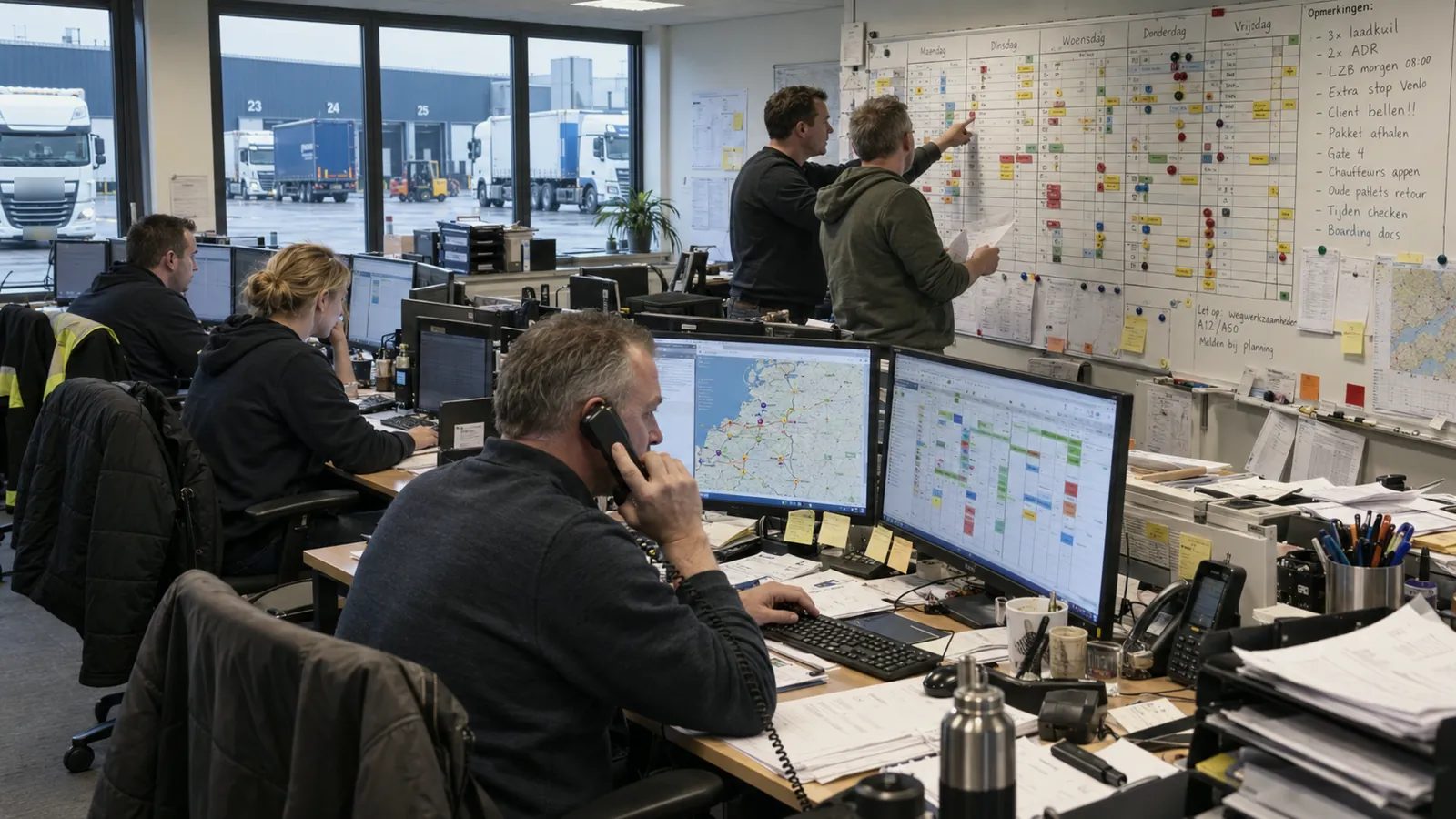
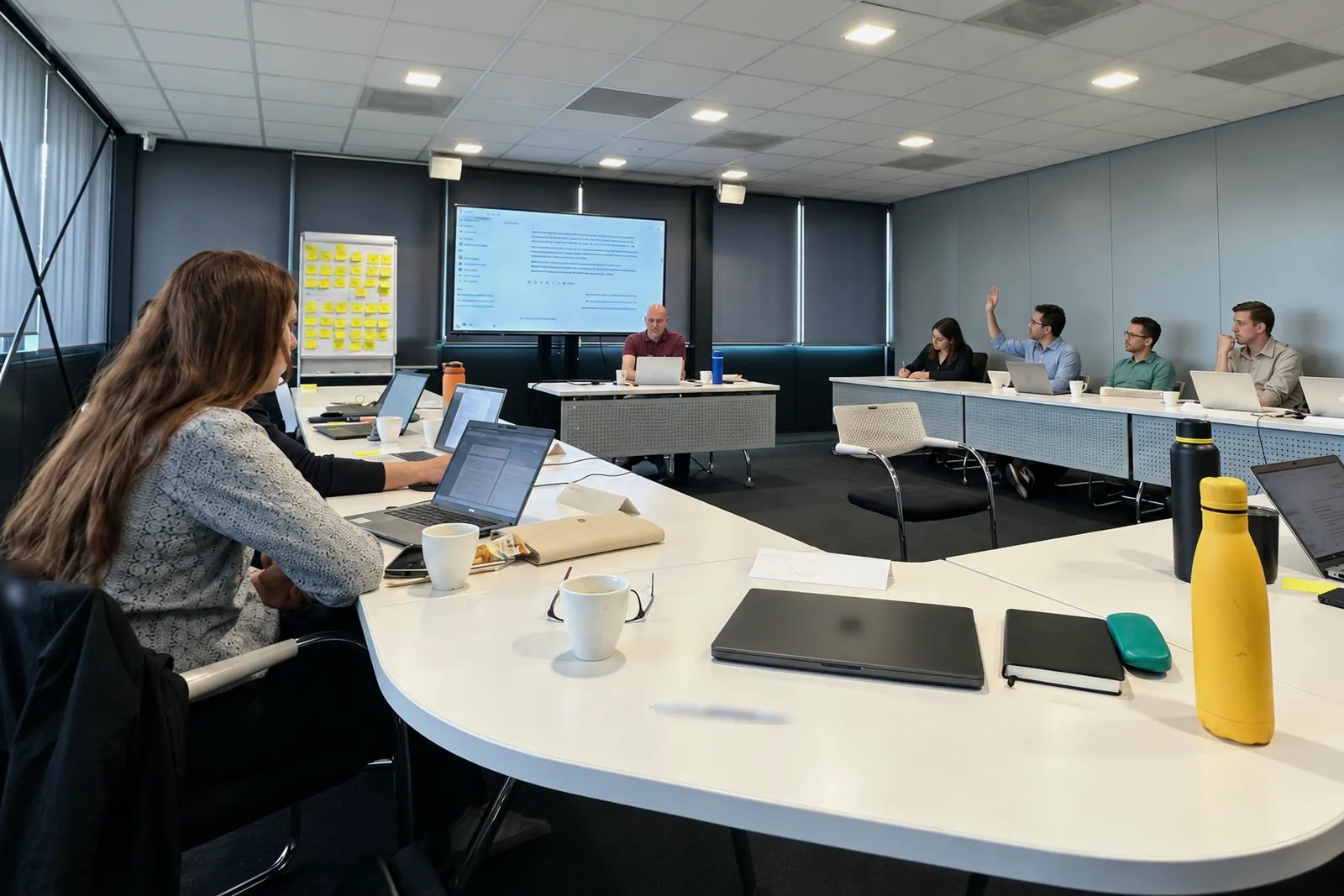
Vos Transport Group plans its entire fleet with a team of planners in the Netherlands and abroad. Their goal every day: as many transport movements as possible, with the best possible planning.
400 → 0manual entries per week
25%time saved per planning
On the shop floor
Before
Information from several systems came together in the planner’s head. Hundreds of manual entries a week, and knowledge that was hard to hand over to a colleague.
After
Data sources talk to each other automatically and input is no longer typed by hand. Planners spend their time on what they are good at: making the planning better.
01
The challenge
Improve the planning without losing the expertise of the planners, and cut out as much manual work as possible. At the start, much of the planning was done by hand, with information from different systems combined in the planner’s head.
02
Our approach
Technology only adds value once the process steps are clear. So we first mapped the process, then looked at what we could improve in the process itself. Only after that did we look critically at what to automate, so planners get more time for optimising.
03
The result
Data sources now connect automatically, so planners no longer search for information by hand and can easily take over from each other. Several input steps are automated, which brings speed, better quality and time savings.
TakeawayFix the process first, then automate it.
Client
AIT Worldwide Logistics
Sector
Freight forwarding
Service
Training and consultancy
Used daily by
Commercial team
Less time on research, more time with clients
AIT prepares every client contact carefully, to check where it can truly add value. An AI agent now does that time consuming analysis, so the team can spend more time talking to clients.
3 → 25client analyses per hour
+21%more client meetings
On the shop floor
Before
A thorough analysis for every prospect, done by hand. Around three an hour, hard to scale and hard to fit in between other work.
After
An agent analyses each client and prepares the first conversation. The team walks into every first meeting knowing where AIT can help.
01
The challenge
AIT analyses every client in depth before making contact. That quality has a price: an intensive approach with only a few contacts per hour. Hard to scale, and hard to do in between daily work.
02
Our approach
We started by training the team to work with large language models, so they could set up the analysis themselves and keep improving it. A look at the full process then showed where automation was possible, while keeping the quality and personal approach AIT is known for.
03
The result
An agent now runs an analysis for every client. It helps the commercial team find the right match and prepares a fitting approach for the first conversation, so they get to the point straight away.
TakeawayAutomate the preparation, not the relationship.
Client
BF Global Group
Sector
Logistics, forwarding and warehousing
Service
Consultancy
Used daily by
Commercial teams in three divisions
Ten times more leads, still a personal first call
BF Global Group has three divisions, logistics, forwarding and warehousing, each with its own commercial team. Finding new clients asks for a tailored approach and specific knowledge per division.
10 → 100qualified leads per week
+18%more client meetings
On the shop floor
Before
Daily work left little time to look for new leads. Prospecting happened now and then, and every division did it in its own way.
After
One central lead flow, checked for fit by AI and shared across the teams. Every lead comes with a client analysis and a call script for the first call.
01
The challenge
Daily work kept the commercial teams from finding new leads that fit the group and making that first contact. When it did happen, it was irregular and different per division, so structure and quality suffered.
02
Our approach
Together with the commercial teams we built one shared approach: leads are generated centrally and then divided across the teams. By combining lead tools with an AI model, we check right away whether a lead fits the group, add a client analysis and write a call script that keeps the contact personal.
03
The result
An automatic lead flow with a ready made format for the first contact, structured and of consistent quality. The teams spend more time on personal contact and make the difference with their own expertise.
TakeawayCentralise the search, keep the conversation personal.
Client
LV Logistics
Sector
Warehousing
Service
Training
Used daily by
Warehouse operations team
AI training that fits a busy warehouse
After an AI talk, the warehousing division of LV Logistics wanted to know what AI could mean for the warehouse today, and how it could help shape the warehouse of tomorrow.
2 daystraining built on their own business cases
Own agentsset up by the team itself
On the shop floor
Before
An operation under pressure from new projects and too few people. Little time, and little appetite for two days of training.
After
The team knows what AI can do and sets up its own agents. The first projects for better data and visibility are being delivered.
01
The challenge
New projects and understaffing put the operation under pressure. People had little time and little motivation for a two day training that explains AI and works through operational business cases to see where AI adds value.
02
Our approach
An AI generated podcast shared part of the content in advance, which people liked. The training itself was built entirely around business cases agreed beforehand, so it had a direct effect on the operation.
03
The result
The operational staff now understand what AI can do and can set up agents on their own. Because the effect on daily work was immediate, AI was adopted quickly within existing processes. The first projects, where AI supports data supply and visibility, are now being delivered.
TakeawayStart with their cases, not with the technology.
Client
evofenedex
Sector
Logistics and international trade
Service
Training
Used daily by
Members in finance, export, planning, warehousing and HR
From inspiration to daily practice in one day
evofenedex wanted a training for its members that goes beyond inspiration. After one day, people from very different organisations and roles had to know how AI works, where the risks are and where they can start in their own work tomorrow.
65%more effective hours planning
80%more effective shortage planning
35%more effective stock planning
On the shop floor
Before
Very mixed groups: from people who had never used AI to daily users, and from finance and export to planning, warehousing and HR. Everyone came with a different question.
After
Every participant went home with one clearly defined process to start on. Three business cases that came out of the trainings now run in practice.
01
The challenge
How do you go from awareness to real use? What can you safely put into an AI tool? And how do you automate manual work when the ERP system falls short? One standard training would be too basic for part of the group and too abstract for the rest.
02
Our approach
Each training started with the expectations of the group, and we shaped the day around them. After a solid base on how a language model works, asking versus instructing, data security and the AI Act, we moved into practice. Participants mapped their own processes step by step, with purchase to pay as a worked example. That showed how many manual steps hide in a simple looking process, and that the biggest gains are often in the exceptions. A SWOT per organisation made the chances and barriers concrete.
03
The result
Several organisations quickly went further than a first step. Three business cases came out of the trainings:
Hours planning: generated automatically, 65% more effective.
Shortage planning: fully automated, 80% more effective.
Stock planning: interactive, 35% more effective.
TakeawayThe biggest gains often hide in the exceptions, not in the standard flow.
Next stop
Where does your team lose time today?
Book a conversation and we will look at your processes together. Practical, and usable from the next day.